

Recipe excerpt from:
Umma
by Sarah Ahn & Nam Soon Ahn
I never used to be a big fan of fried chicken. There wasn’t anything in particular that I disliked about it, but I just never craved it or cared much for it. That all changed when I tried Korean fried chicken for the first time at Jin Mi Chicken, a bustling restaurant in Suwon, South Korea. There, they serve only two flavors: plain fried chicken and spicy glazed fried chicken. My uncle had ordered two large plates of each flavor for us. “Is this for the entire family?” I asked him. “No, this is just for you.
Trust me, you’ll finish the entire thing.” I recall feeling a bit anxious as I faced Samchon’s expectation that I would be able to finish two plates full of fried chicken; however, as I took my first bite, my concern gave way to amazement. This was the most delicious fried chicken I had tasted to date, and my memories will not let me forget it. The outside was perfectly crisp and seasoned with a blend of savory spices, complementing the soft and juicy chicken meat underneath. Before I knew it, I had two buckets in front of me filled with nothing but bones. Upon returning home to the United States, I struggled to find Korean fried chicken that matched the quality and taste I had experienced at Jin Mi Chicken. While many restaurants offer decent versions, nothing was as memorable as what I had eaten in Korea. That is, until Umma developed her own fried chicken recipe, inspired by my described memory.
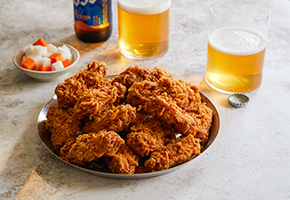
To me, Umma’s fried chicken is not just “good enough”— It’s exceptional. It brings me back to the amazement that I felt in Korea. Her fried chicken is a work of art—perfectly crispy, yet light and flavored with a harmonious blend of spices. Described by Umma as a “wave-patterned” crust (meant to resemble the waves of the ocean) and accomplished by “shocking” the battered chicken by tapping it against the bowl before frying it, the distinctive pattern is key to achieving the signature crisp and crunch. Having now shared this with friends, family, and fried chicken lovers in my life, I can say that Umma’s fried chicken has been repeatedly hailed as some of the best.
SERVES 4 to 6
TOTAL TIME 11⁄4 hours, plus 3 hours soaking and seasoning
- 3 pounds (1.4 kilograms) chicken wings, cut at joints,
- wingtips discarded
- 21⁄2 cups milk
- 2 teaspoons black pepper, divided
- 1 teaspoon miwon matsogeum (MSG seasoning salt)
- 31⁄2 cups (420 grams) Korean frying mix, divided
- 5 tablespoons (50 grams) curry powder, divided
- 1 tablespoon Dasida beef stock powder
- 1 tablespoon garlic powder
- 1 tablespoon onion powder
- 11⁄2 cups cold water
- 2–3 quarts vegetable oil for frying
- Rinse drain the chicken, then transfer it to a large bowl or container. Add the milk and toss to coat. Arrange the chicken in an even layer, making sure all the chicken is submerged in the milk. Cover and refrigerate for 1 hour.
- Drain and thoroughly rinse the chicken until the water runs clear. Clean and dry the bowl. Using the tip of a sharp paring knife, pierce each wing 3 to 5 times on each side around the bone (the tip of the knife should puncture through to the other side). Pat the chicken dry with paper towels and transfer to the bowl.
- Add 1 teaspoon pepper and the seasoning salt and toss the chicken to coat. Cover and refrigerate for at least 2 hours or overnight.
- Set a wire rack in a rimmed baking sheet. Following the manufacturer’s instructions, heat the oil in an electric fryer to 330 degrees. Whisk 11⁄2 cups (180 grams) frying mix, 3 tablespoons curry powder, the Dasida powder, garlic powder, and onion powder together in a separate large bowl. Gradually whisk in the cold water until the batter is just combined (it’s okay if small lumps remain; be careful not to overmix). Add the chicken and toss to coat it in the batter.
- Whisk the remaining 2 cups (240 grams) frying mix, remaining 2 tablespoons curry powder, and remaining 1 teaspoon pepper together in a medium bowl. Working with 1 piece at a time, use tongs to fully coat the chicken in the batter once more. Lift the wing, allowing excess batter to drip back into the bowl, and transfer it to the seasoned frying mixture. Using your hands, toss the wing to coat it (do not press the piece into the flour), then gently tap the wing against the side of the bowl twice to “shock” it (this is what gives the fried chicken its wave pattern). Carefully lower half of the wing piece into the hot oil, hold for 3 seconds, then release the piece completely into the oil. Repeat with 5 more wing pieces. Cook, undisturbed, for about 2 minutes, then use the tongs to release the wings from the base of the fryer basket. Continue to cook, turning the wings occasionally, until golden brown and crisp and the chicken registers at least 165 degrees, 5 to 7 minutes for wingettes and 7 to 10 minutes for drumettes.
- Using a slotted spoon, transfer the wings to the prepared rack as they finish cooking. Return the oil to 330 degrees and repeat with the remaining wings in batches. Serve.
Umma’s Kitchen Wisdom
I prefer to use Ottogi brand mild curry powder for this recipe, but other mild curry powders work too. I love the convenience of pre-split chicken wings and opt for smaller wings whenever possible. I also cook the wingettes and drumettes separately, since they have different cooking times.
I use an electric deep fryer for my fried chicken, though you can also use a large, wide pot or Dutch oven that holds 6 quarts or more. Add the oil to the pot until it measures about 2 inches deep and heat over medium- high heat to 330 degrees. Adjust the heat as needed to maintain the temperature.
Excerpted from Umma by Sarah Ahn & Nam Soon Ahn . Copyright © 2025.
Courtesy of America’s Test Kitchen, All Rights Reserved. Photo by Kritsada Panichg
Author headshots photography credit Jake Choi